Autonomous Transit
Our own flagship simulation — built to validate the platform's dispatch, parking, and mesh logic before we put it in front of a single customer network.
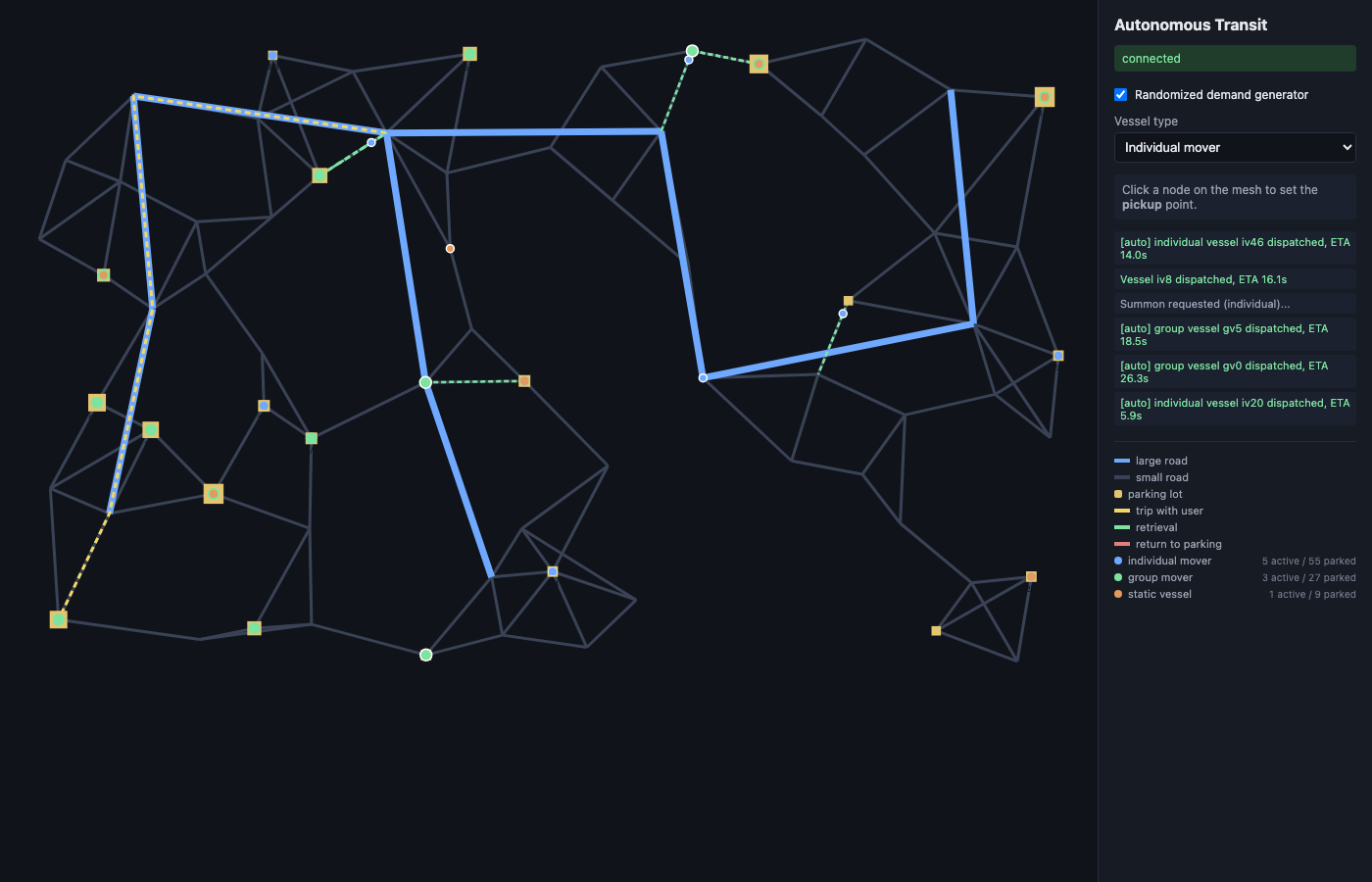
Summon-and-dispatch, not continuous circulation
Most fleet simulations assume vehicles are always moving. We built Autonomous Transit around a different premise: vehicles sit parked until summoned, then the system finds the best one for the job. A Python backend owns the mesh, the fleet, and the parking inventory, and runs the whole simulation itself — every connected viewer just watches the same authoritative world update by update, rather than each running their own copy.
Three vessel types, two lifecycles
Individual mover
Picks up a single rider, delivers them, then returns to the nearest open parking lot to wait for the next call.
Group mover
Same lifecycle as an individual mover, sized for multiple riders per trip.
Static vessel
Delivers its rider, then stays parked at the destination in active use for a while — think a mobile unit making camp — before becoming summonable again from wherever it stopped.
ETA-first assignment, contention-free parking
When a rider summons a vessel, the system filters to eligible, idle vessels and picks whichever has the shortest calculated travel time to the pickup point — not simply the nearest by distance, since routes cross both fast and slow roads. The same logic runs in reverse for parking: a vessel claims its parking spot the instant a return trip begins, so two vehicles finishing around the same time never contend for the same space. Concurrent requests from many riders at once are resolved without any risk of double-booking a vessel.
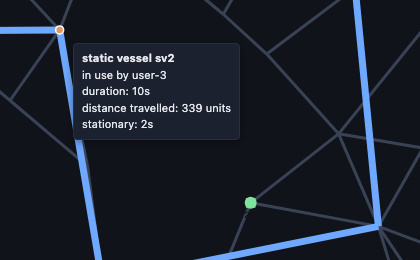
One world, unlimited viewers
The simulation runs on a fixed server tick, independent of any browser tab. Every connected client — an operator, a stakeholder reviewing a scenario, a teammate on another floor — sees an identical, live view of the same fleet, because there is exactly one simulation, not one per viewer. On the client, motion is smoothed to 60 frames per second between server updates, so the shared world still feels immediate even though the authoritative tick runs slower.
This is what a simulation-first fleet looks like
We can build the same kind of environment around your network, your vehicles, and your demand pattern.
Talk to us